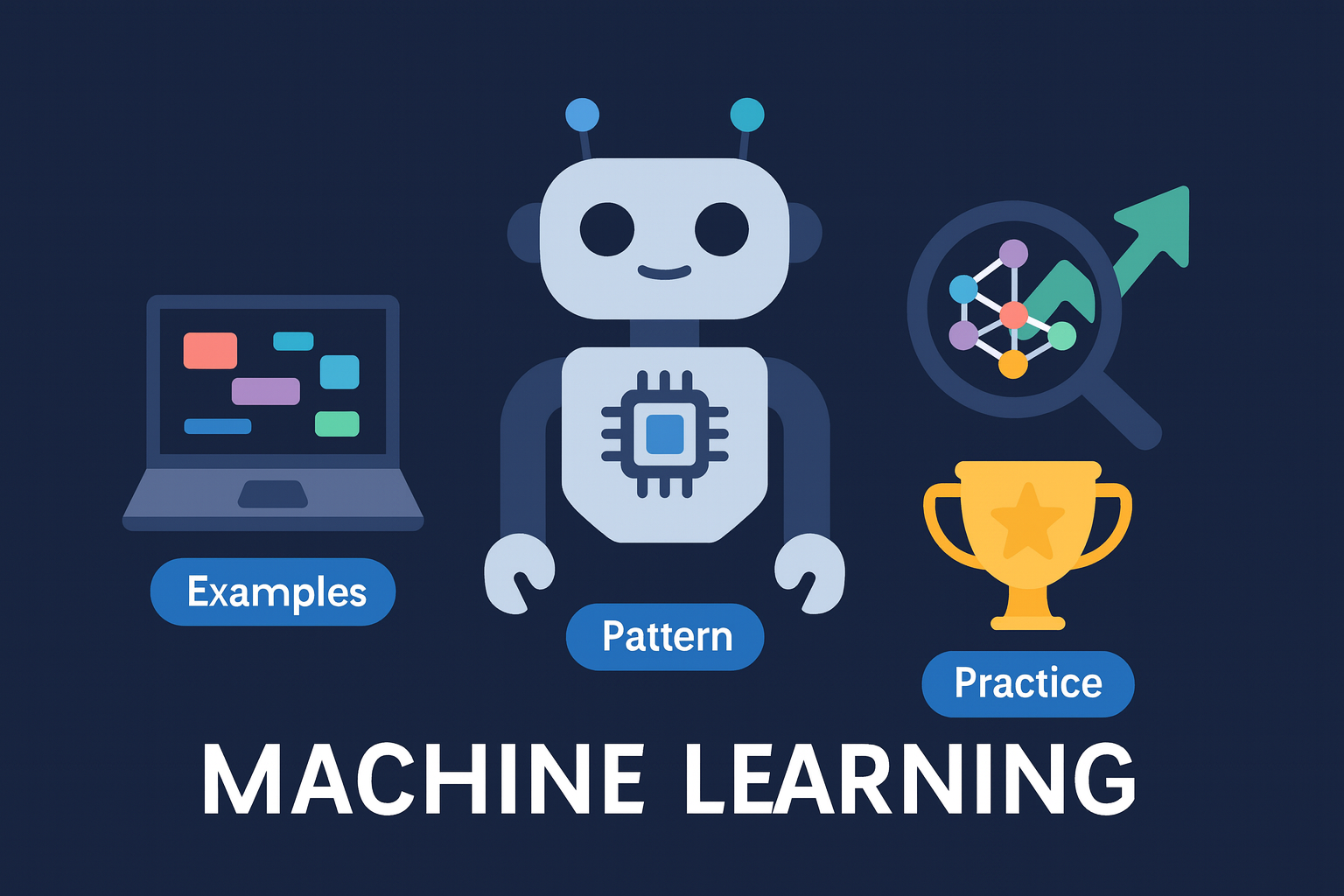
Machine Learning (ML) shows up everywhere today — in your phone, your car, your bank app, your camera, and almost every modern AI tool. But what exactly is ML, and why do so many industries depend on it?
This guide breaks ML down in plain language, the same way an engineer or student would explain it on the shop floor, in class, or at a coffee break. No heavy math — just intuition.
What Is Machine Learning?
Machine Learning is a way for computers to learn patterns from data instead of following a long list of fixed, hand-written instructions.
Think of it like teaching someone a new skill:
- You give examples.
- They look for the pattern.
- They improve with practice.
Computers learn the same way — just with thousands or millions of examples instead of a few.
A simple example
Give a model thousands of labeled photos of cats, and it slowly learns what “cat-ness” looks like. Feed it transaction data, and it learns which patterns look suspicious. Train it on driving video, and it learns to recognize lanes, objects, and movement.
Why ML Matters in the Real World
ML powers some of the technology you use daily, often without you noticing. A few quick examples:
Phones
Face unlock, voice-to-text, smart photo filters, and spam blocking all rely on models trained on massive datasets of images, audio, and text.
Cars
Driver-assist systems use ML to detect lanes, vehicles, and pedestrians, and to estimate what might happen next on the road.
Finance
Banks use ML to flag unusual card activity, score credit risk, and detect patterns that might indicate fraud long before a person could spot them.
Healthcare
ML models assist doctors by analyzing X-rays, MRIs, or lab results, helping to detect patterns that can be hard to see with the human eye alone.
Everyday apps
Recommendation systems, translation tools, maps routing, and smart email replies all depend on ML models that continuously learn from user behavior.
How Machines Actually Learn (Simple Version)
Training an ML model usually follows a three-stage cycle. You’ve probably seen this diagram in class; this is the plain-English version.
1. Training
The model sees many examples and tries to learn the pattern. For example, you might feed it 100,000 images of cars and pedestrians, each with the correct label.
2. Validation
Next, we check how well the model performs on data it hasn’t seen. We tune settings and make sure it’s not just memorizing the training set.
3. Testing
Finally, we evaluate the model on a separate dataset to estimate how it will behave on real-world data.
Types of Machine Learning
Most ML systems fall into three main categories. The names are academic, but the ideas are straightforward.
1. Supervised Learning — “I give you examples with answers.”
In supervised learning, the model is trained with labeled examples — each input comes with the correct output.
Examples include:
- Email classification: spam vs not spam
- Camera images: pedestrian vs vehicle vs background
- Finance: normal purchase vs potential fraud
This is the most common type of ML, especially in automation and safety-critical work, because you know exactly what you’re training toward.
2. Unsupervised Learning — “Just find patterns.”
In unsupervised learning, there are no labels. The model just looks at the data and tries to group similar points together or discover structure.
Examples:
- Grouping customers by spending behavior
- Finding clusters in sensor readings
- Clustering similar webpages to improve search
This is powerful when you don’t know exactly what you’re looking for yet — you let the data suggest patterns.
3. Reinforcement Learning — “Learn by trial, error, and reward.”
Reinforcement Learning (RL) is based on feedback. The model takes an action, sees what reward or penalty it gets, and slowly learns a strategy.
Examples:
- Robots learning to walk or balance
- Game-playing AIs mastering Chess, Go, or Atari games
- Systems that optimize scheduling, routing, or resource use over time
Why ML Makes Mistakes (Bias, Variance & Noise)
ML is powerful, but not perfect. The same concepts you see in your DeVry modules show up in real projects: bias, variance, and noise.
Bias — too simple
A model with high bias oversimplifies. It might try to force a straight line through curved data or ignore important features. It’s consistent, but often wrong.
Variance — too sensitive
A model with high variance pays attention to every tiny detail in the training set and fails when faced with new data. It “memorizes” instead of understanding.
Noise — messy data
If the data is inconsistent, incomplete, or biased, the model will absorb those issues. Bad data leads to bad predictions, no matter how fancy the algorithm is.
Machine Learning Inside DGxOne
DGxOne is built around a local-first philosophy: no tracking, no surprise data hoarding, and cloud calls only when you choose BYOK.
ML appears in DGxOne through the models you connect — whether that’s OpenAI, Gemini, or Grok — and in how the app helps you:
- Understand natural language requests
- Reason through tasks and problems
- Power future vision features like OCR and object detection
- Support audio handling and transcription pipelines
You keep your keys. You own your data. The ML is there to make the tools clearer and more useful, not to build a profile on you.
Final Takeaway
Machine Learning isn’t magic. It’s pattern recognition powered by data, examples, and practice. The better the data and the clearer the goal, the more helpful the model becomes.
When you understand how ML works — even at a beginner level — you get a clearer view of what AI can and can’t do, where it’s strong, and where human judgment still matters.
That’s the heart of DGxOne: AI that helps you, without taking control away from you.